
January 5, 2026
Info
Why €414 Billion Can't Find a Home: 5 Surprising Truths About Europe's Hidden Deal Market
The Great Contradiction
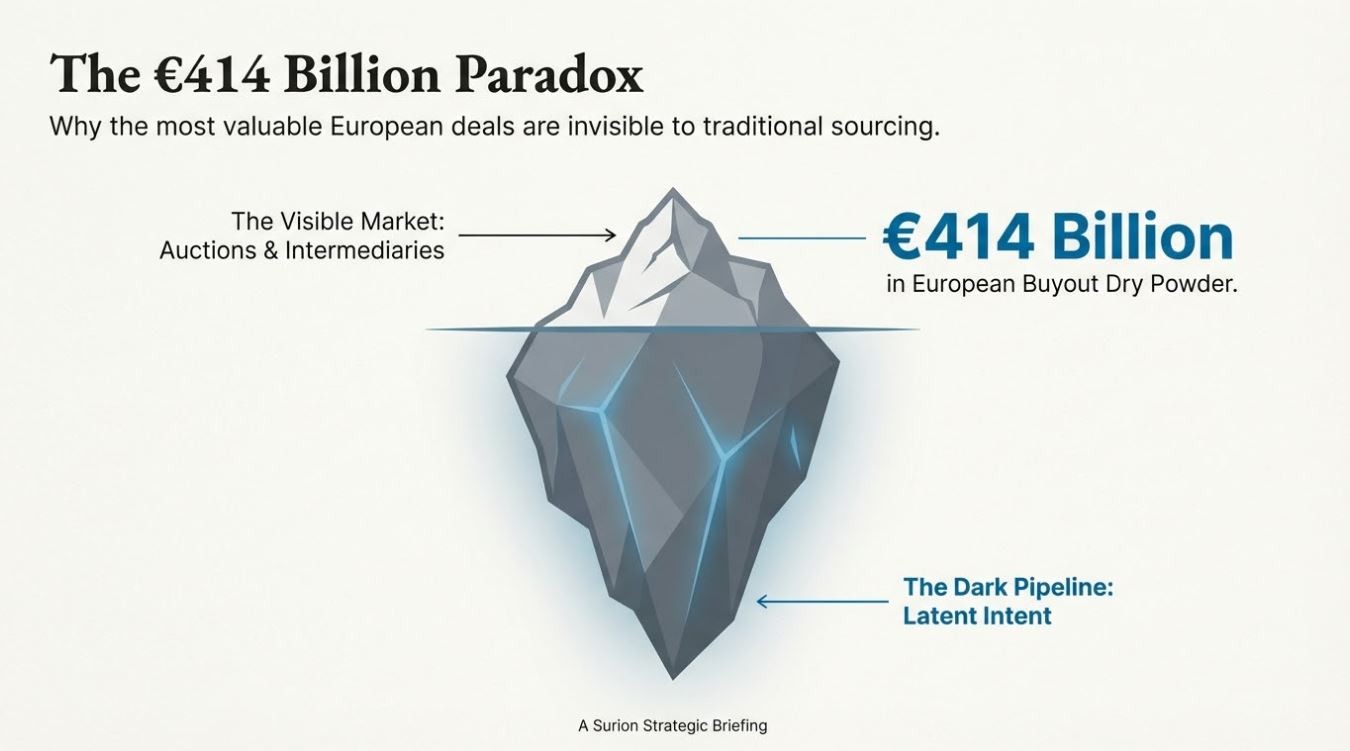
The European private equity landscape is defined by a great contradiction. On one side, a staggering €414 billion in "dry powder" sits ready for deployment into European buyouts. On the other, the volume of high-quality, actionable deals in the visible market has stagnated, creating a hyper-competitive "Red Ocean" where firms overpay for a limited pool of commoditized assets.
This begs a critical question: with so much capital chasing so few opportunities, where are all the good deals hiding?
The answer is that the best opportunities are not in the visible market at all. They exist in a vast, submerged ecosystem of privately-held companies. This article reveals five surprising truths about this hidden deal market and the strategic shift required to access it.
1. That "Proprietary Deal" You're So Proud Of? It's Probably Not.
In the world of private equity, "proprietary deal flow" is the ultimate differentiator. Funds tout their ability to source off-market transactions as proof of their unique access and ability to secure better terms. The reality, however, is that a truly proprietary deal—initiated directly by a buyer with a business owner, involving no intermediary - is statistically rare, making up a single-digit percentage of closed transactions for most mid-market funds.
What most firms label as "proprietary" are actually "pocket listings" or "warm intros" from advisors who quietly shop an asset to a small, pre-selected list of buyers. While preferable to a wide auction, this still introduces competitive tension. The moment an intermediary is involved, their duty is to maximize price, eroding the very alpha the buyer was seeking.
This reliance on referral networks also creates a significant risk of adverse selection. High-quality assets are typically advised to run broad auctions to achieve the highest valuation. Consequently, the deals shopped quietly often have underlying flaws that have deterred other buyers.
"Warm intros" frequently function as a recycling mechanism for opportunities that have already failed to gain traction in the primary market, leaving the recipient of the "proprietary" referral to sift through the debris of other investors' rejections.
2. The Best Companies Aren't For Sale (Until You Make Them an Offer They Can't Refuse).
The most valuable European assets are not found in an investment bank's pipeline. They are located in the "Dark Pipeline"—a vast ecosystem of business owners who have "latent intent" to sell but have not yet started a formal process. These opportunities are typically 18 to 36 months away from a transaction.
The psychology of these owners, particularly in family-run European businesses like the German Mittelstand, is key. For them, selling is not just a financial event; it is the dismantling of a multi-generational legacy, a decision fraught with emotional complexity. They often view a sale as a potential betrayal of the social contract with their employees and community, making the aggressive, impersonal nature of a formal auction process antithetical to their cultural and psychological needs.
A profound fear of "being shopped" protects the Dark Pipeline. Owners worry that a public sale process will damage their reputation, alert competitors, and create unrest among employees. This psychological barrier means the best companies will never enter the visible market on their own. Accessing them requires a fundamental strategic shift: moving from passive "origination" (finding deals that are for sale) to proactive "inception" (cultivating the owner's decision to sell in the first place).
3. In This Market, Speed Kills. The Real Alpha Is Patience.
There is a fundamental timeline mismatch between the urgency of traditional private equity and the generational clock of the Dark Pipeline. The conversion cycle for a hidden deal is not a 3-6 month sprint; it is an 18 to 36-month marathon built on the speed of trust, not the speed of finance.
This lifecycle breaks down into three distinct phases:
1. Inception (Months 1–12): The initial focus is on building trust and credibility. The goal is to move from "stranger" to "trusted acquaintance," not to discuss a deal.
2. Nurturing (Months 13–30): Through consistent, low-pressure contact, the owner's latent intent is slowly crystallized. This phase involves sharing market insights and discussing the future, not pitching a transaction.
3. Execution (Months 31–36): A trigger event—such as a health issue, succession failure, or major capital expenditure need—occurs. Because a trusted relationship already exists, the owner turns to their established contact instead of a broker, enabling a quiet, bilateral negotiation.
This long timeline acts as a natural moat. Most private equity firms, driven by deployment pressure and high turnover in junior roles, lack the incentive or organizational structure to maintain a relationship for three years without a guaranteed transaction.
This moat of patience is compounded by a second, even more formidable barrier: the fortress of cultural fragmentation.
4. Europe Isn't One Market. It's a Cultural Minefield.
A "Pan-European" sourcing strategy that applies a uniform playbook across the continent is destined to fail. Europe is a mosaic of distinct languages, cultures, business etiquettes, and legal systems. Success requires a "multilocal" approach that respects deep regional fragmentation.
The following data, based on analysis from Surion Strategy and market reports, quantifies this Deal Sourcing Complexity in Europe:
Region | Language Barrier (out of 10) | Cultural Hurdles (out of 10) | Regulation (out of 10) | Overall Complexity (out of 10) |
France | 9 | 9 | 10 | 9 |
Southern Europe | 8 | 7 | 7 | 7 |
DACH | 7 | 6 | 6 | 6 |
Nordics | 4 | 2 | 3 | 3 |
UK & Ireland | 1 | 3 | 3 | 2 |
The data clearly shows that while the UK & Ireland are relatively open, France and the DACH region present formidable, multi-layered barriers that protect their local markets from unsophisticated capital. Successfully navigating this landscape requires deep local expertise.
• DACH Region (Germany, Austria, Switzerland): Sourcing here demands native German speakers. The narrative must focus on "Succession" (Nachfolge) and "Stewardship" (Verantwortung), avoiding Anglo-Saxon financial jargon. There is a historical distrust of private equity, once famously branded as "locusts" (Heuschrecken).
• France: This market presents the dual barriers of language and law. Critically, the "Works Council" (Comité Social et Économique) has legal rights to be consulted on any sale, and any approach that fails to acknowledge the social implications of a deal will be rejected.
It is this deep-seated cultural and linguistic fragmentation that renders the standard high-volume outreach model not just ineffective, but actively destructive.
5. Your "Volume" Outreach Strategy Is Actively Destroying Your Opportunities.
The traditional "spray and pray" email strategy - blasting thousands of generic messages - is mathematically and reputationally bankrupt in Europe. Typical cold email reply rates for M&A outreach hover at a dismal 2-4%.
In the finite markets of Europe, this approach does more than fail; it actively causes harm by "Burning the TAM" (Total Addressable Market). For example, in a specialized German vertical with only 200 relevant companies, a low-effort campaign might yield four conversations. But in the process, it alienates the other 196 targets, making it exponentially harder to ever re-engage them. By contrast, a highly targeted, localized, and researched approach can achieve reply rates of 15-20%.
The primary reason owners don’t reply to cold outreach is not a lack of interest, but a lack of trust. When a private equity associate emails an owner, an adversarial frame is immediately set: the buyer wants the lowest price, the seller the highest. The winning strategy is to shift the message from "I want to buy you" to "I want to understand your business." This involves decoupling the "sourcing" function from the "capital" function, allowing a neutral, expert-led conversation to begin—one focused on curiosity, not commerce.
Conclusion: Are You Hunting or Are You Farming?
The era of passive, intermediated deal flow is over. The visible market has become a zero-sum game where victory often means overpaying for a commoditized asset. The choice facing capital deployers in Europe is binary:
Compete in the Red Ocean, battling record levels of dry powder and fighting for the same small pool of auctioned deals.
Or, navigate the Dark Pipeline, building the systems required to identify latent intent months or years before the market does, and securing proprietary access to the continent's hidden champions.
The real European deals are hiding in the minds of owners waiting for the right conversation - is your firm equipped to start it?